
Our Approach
We help define who you are to the next generation.
Identify Key Audiences
We start by learning the motivations and needs of your audiences.
Future Student
How do students choose an education that is worth the money, creating opportunities for rewarding careers without going into debt?
Student and Alumni
Students love the small class sizes and experiential education your college offers but need help balancing school, work and family obligations.
Staff and Faculty
When students are engaged, staff and faculty have a powerful impact. The college needs to find ways to engage by traditional and nontraditional means.
Community and Corporate Partners
Our community recruits strong graduates for the workforce, but we need an increase in graduates for the future.
Build Brand Archetype
Each family of archetypes aligns with a set of motivations that span a range of collective and individualistic desires.
From 12 archetypes, we narrow down your primary, secondary and tertiary types.
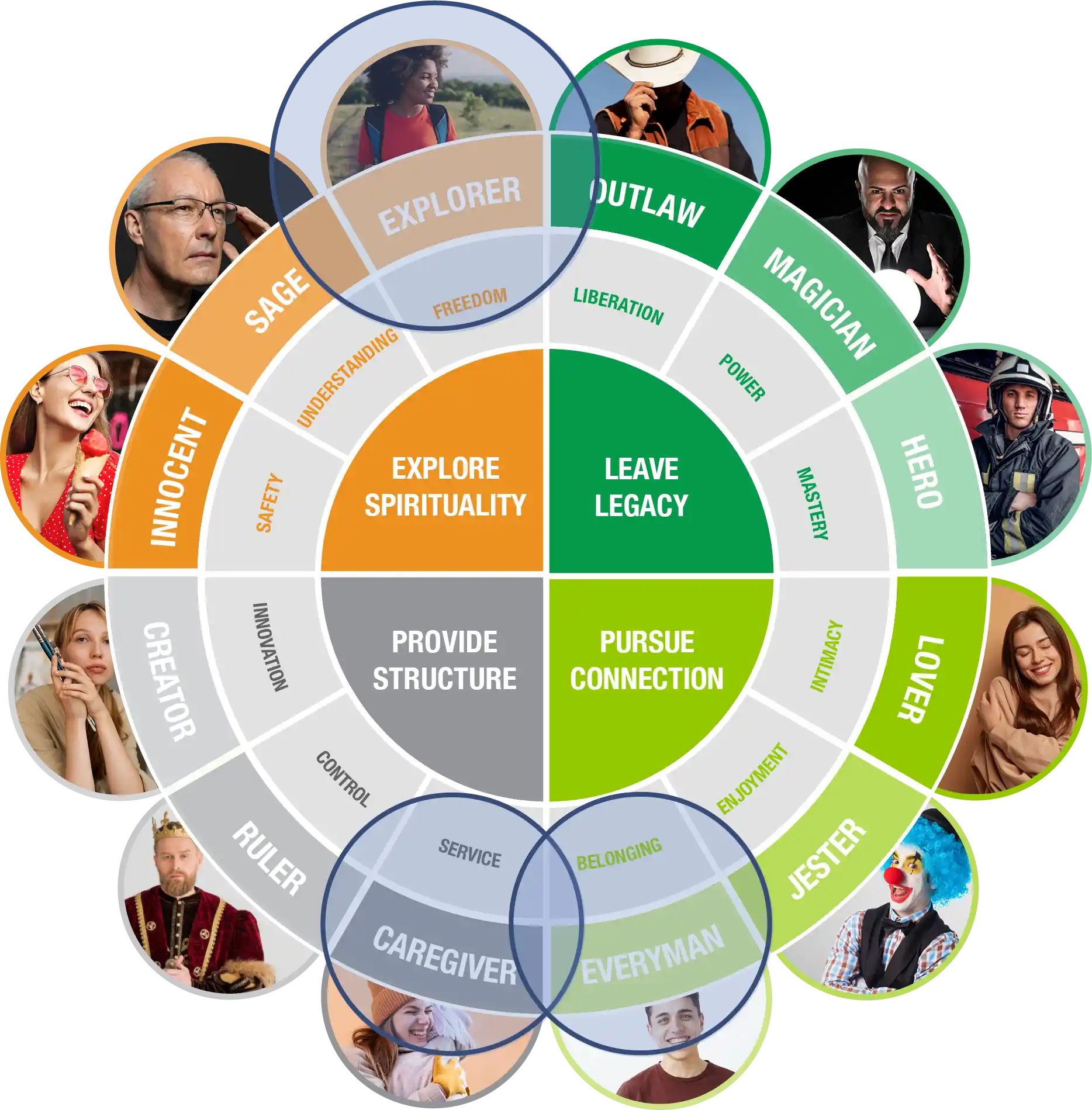
This example of a small college showcases three types. Each archetype has a different set of needs and motivations. These inform the work we do.
Brand Narrative Is the Vehicle to AI Legibility
A brand isn’t what you say it is. It’s the gut feeling people carry about you.
Of everything we call marketing — advertising, PR, design, the rest — only one thing earns real recognition: customers telling others how they feel about you. Everything else is a version of talking at people. So we start with meaning, not tactics.
For thirty years, marketing chased the click: optimize for search, rank the page, drive volume. That was rented attention, and AI has ended it. As click-through rates fall and acquisition costs climb, the game shifts from winning the click to winning the citation.
Large language models don’t reward the loudest voice; they surface the most authoritative one. When someone asks an AI about your category, it cites high-signal, high-trust sources — and you have to earn that recommendation. Ironically, the old-school disciplines of brand and earned media are suddenly the most modern tools we have.
In many ways, generative AI has brought marketing back to 2007 — back to when we talked about communications and authority more than digital, demand generation, and UTMs. New school is old school again. The organizations that win are the ones building a verified, credible, authoritative presence in the sources these models trust most.
Win the Citation
Meaning is the foundation. These are the disciplines that make your brand legible to the models people now ask first.
Earned Media & Authority
Nothing is more authoritative to an LLM than independent, edited, earned media. We put your experts and points of view into the press — and into the reference platforms models lean on most — because high-signal, widely shared content is what AI trusts and surfaces.
Answer Engine Optimization
We engineer content around the real questions people ask, structured with FAQ schema so answer engines can read, trust, and cite it. The goal isn’t more content — it’s more legible content.
Knowledge Graphs
AI is trying to reason like a person: understanding how one entity relates to another. We make the relationships between your brand, your programs, and your mission explicit, so models understand what you are known for.
The Signal, Not the Stream
AI legibility does not mean making more content. It means making better, higher-authority content worth citing. Develop a point of view worth sharing. Create stories people remember. Turn real outcomes into evidence of your mission, rather than flat promotion no one is moved to pass along. If people don’t care about it, AI won’t either.
And the order matters. You don’t paint the house before you pour the foundation. We interview cohorts of your key audiences, claim the archetype — or two, sometimes three — that genuinely fits, study who already occupies that space, and zag into your own. Only then do we rebuild the surface: the site, the words, the creative. Only then do we begin earning authority.
Here is the test we ask every partner: if you went quiet for ninety days, would anyone truly miss you? If the answer isn’t an immediate yes, it usually isn’t a sales or marketing problem — those are amplifiers, not identity. It’s a meaning-and-relevance problem. Archetype and onlyness, in that order, are how we fix it.
Organize for the Next Decade
Centralized or Decentralized? Your organizational structure matters.